


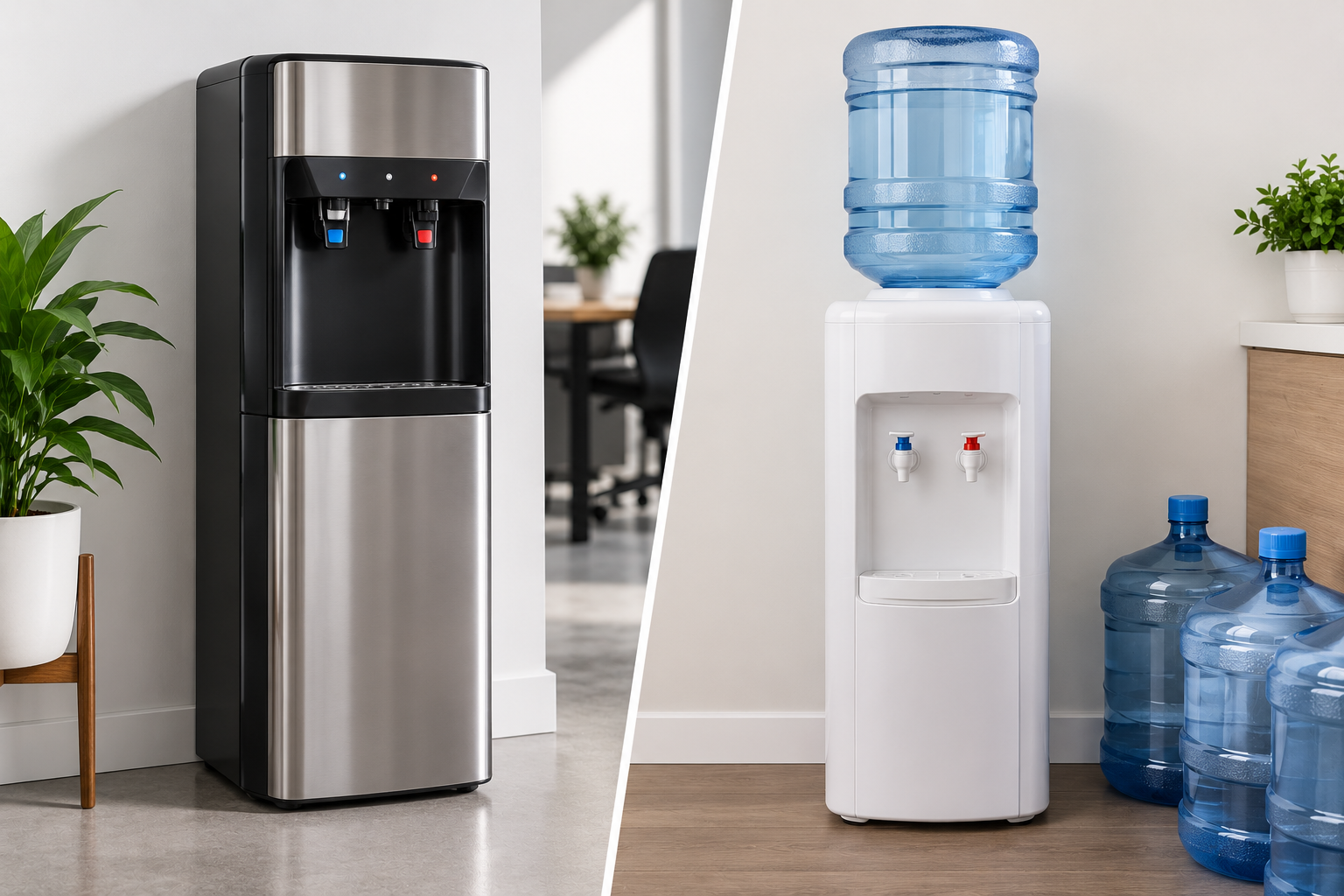
Choosing between a bottleless water cooler vs. bottled water depends on your water usage, available space, access to a water line, maintenance preferences, and budget. Bottleless coolers connect directly to a building’s water supply and use filtration to provide drinking water without storing or replacing large jugs. Bottled water coolers can be practical when a water-line connection isn’t available, but they require recurring deliveries, bottle storage, and regular bottle changes.
When comparing a bottleless water cooler vs. bottled water, the biggest difference is where the drinking water comes from. A bottleless cooler connects to the building’s water supply and treats the water through an integrated filtration system. A traditional bottled cooler draws water from large bottles that must be delivered, stored, and replaced as they are emptied.
Both approaches can provide convenient access to drinking water in homes, offices, break rooms, waiting areas, and other spaces. However, their costs, maintenance requirements, filtration capabilities, and day-to-day logistics are different.
Understanding those differences can help you choose a system based on how much water you use and what matters most for your space instead of simply choosing the option that looks less expensive upfront.
Quick Facts: Bottleless vs. Bottled Water Coolers
How Does a Bottleless Water Cooler Work?
A bottleless water cooler connects directly to a cold-water line and passes the incoming water through an integrated filtration system before dispensing it.
The specific filtration technology varies by equipment. Some systems use sediment and activated carbon filtration, while others may incorporate additional treatment technologies depending on the incoming water and desired finished-water quality.
Because the cooler uses the building’s existing water supply, there is no large bottle to replace when the water runs out. As long as the cooler has a functioning water connection and is properly maintained, it can continue producing drinking water as needed.
This makes bottleless systems particularly useful in offices and other high-use spaces where multiple people may refill glasses and bottles throughout the day.
How Does Bottled Water Delivery Work?
Bottled water delivery uses prefilled water jugs that are delivered to the home or business and installed on a compatible dispenser.
When one bottle becomes empty, it is removed and replaced with a full bottle. Depending on the service, empty bottles may be collected and reused rather than discarded after a single use.
This setup does not necessarily require a direct plumbing connection, which can make bottled coolers practical for spaces where installing a dedicated water line would be difficult or undesirable.
The tradeoff is logistics. Users need enough full bottles available between deliveries, a place to store them, and someone capable of changing them when necessary.
Is a Bottleless Water Cooler Cheaper Than Bottled Water Delivery?
A bottleless water cooler may reduce recurring water delivery expenses, but whether it costs less overall depends on water usage, equipment costs, installation, maintenance, and the bottled delivery plan being compared.
Bottleless systems may involve installation and equipment expenses upfront. Ongoing costs can include replacement filters, routine service, sanitation, electricity, and the relatively small amount of municipal or well water being treated.
Bottled delivery typically shifts more of the expense into recurring costs. Depending on the provider, those costs can include water, equipment rental, delivery, bottle deposits, and other service charges.
Usage is particularly important. An office that consumes several bottles every week may have a very different cost comparison than a household that uses relatively little cooler water.
When comparing bottleless and bottled systems, calculate the total cost over time. Include equipment, installation, filters, maintenance, water delivery, bottle-related charges, and expected water consumption. The lowest upfront cost isn’t necessarily the lowest long-term cost.
Bottleless Water Cooler vs. Bottled Water: Side-by-Side Comparison
| Factor | Bottleless Water Cooler | Bottled Water Delivery |
|---|---|---|
| Water Source | Building water supply | Delivered water jugs |
| Installation | Requires access to an appropriate water line | Typically does not require a direct water connection |
| Storage | No water-jug storage required | Space needed for full and empty bottles |
| Ongoing Tasks | Filter replacement, cleaning, and service | Bottle replacement, storage, and cooler cleaning |
| Supply | Continuous while the water supply and equipment are functioning | Limited by the number of full bottles on hand |
| Best Fit | Spaces with plumbing access and regular water demand | Spaces where connecting to a water line isn’t practical |
Which Option Is More Convenient?
Bottleless water coolers generally reduce the day-to-day work associated with managing a supply of water jugs.
There are no heavy bottles to lift onto the dispenser, no inventory to monitor, and no need to schedule water deliveries simply because the supply is running low. Businesses also avoid dedicating storage space to multiple full and empty bottles.
Bottled water has a different type of convenience. Because the dispenser does not need to be connected directly to the building’s water supply, it can work in locations where plumbing access is limited.
For a low-use area, that flexibility may outweigh the inconvenience of changing and storing bottles. For a busy office, however, frequently replacing empty jugs can become a recurring chore.
Which Water Cooler Takes Up Less Space?
The dispenser itself may have a similar footprint, but bottleless systems typically require less additional storage space because there is no inventory of water jugs.
This can matter in offices where closets, kitchens, break rooms, and storage areas are already crowded. Several replacement bottles can consume significantly more space than the cooler alone.
Bottled systems also require space for empty containers until they are collected or returned.
If floor and storage space are limited, look at the entire setup rather than comparing only the dimensions of the dispensers.
What About Environmental Impact?
Bottleless coolers eliminate the recurring transportation and handling of large water bottles, but environmental comparisons depend on the equipment, water source, delivery distance, bottle reuse practices, energy consumption, and other factors.
It’s also important to distinguish large cooler bottles from disposable single-use water bottles. Many bottled-water delivery programs use containers that are collected, cleaned, refilled, and reused.
A bottleless system can still reduce dependence on recurring deliveries and the resources involved in transporting heavy containers. For an organization trying to reduce deliveries or simplify its drinking-water supply chain, that can be an important consideration.
If reducing bottled-water use is a priority, pair a bottleless cooler with reusable cups or refillable bottles. This addresses both the water supply and how people consume it throughout the day.
Does Bottleless Water Taste Better Than Bottled Water?
Neither bottleless nor bottled water automatically tastes better. Taste depends on the source water, treatment method, equipment condition, filter type, and individual preference.
A properly maintained bottleless cooler can reduce certain substances associated with unwanted taste and odor when its filtration system is designed to address them. However, different bottleless systems use different filtration technologies.
Bottled water can also vary in taste because different products may come from different sources and undergo different treatment processes.
If taste, odor, hardness, chlorine, sediment, or another water-quality concern is driving the decision, identifying the cause first can help determine what type of filtration makes sense.
Which Option Requires Less Maintenance?
Both bottleless and bottled water coolers require maintenance, but the responsibilities are different.
Bottleless systems need routine cleaning and filter replacement. Depending on the equipment and incoming water conditions, other components may also require inspection or service. Filter-change intervals should follow the equipment manufacturer’s recommendations and actual usage rather than a universal schedule.
Bottled dispensers still require regular cleaning and sanitation even though they don’t have the same integrated filtration components. Users also need to manage bottle replacement and delivery.
A filtration system is only as useful as its condition allows. Filters that are overdue for replacement or equipment that isn’t cleaned and serviced appropriately can affect performance and water quality.
How Do You Choose Between Bottleless and Bottled Water?
Choose based on how the cooler will actually be used rather than assuming one option is universally better.
Ask these questions:
- How many people will use the cooler each day?
- How much drinking water does the household or business typically consume?
- Is there an accessible water line near the desired cooler location?
- How much space is available for storing full and empty bottles?
- Who will be responsible for replacing heavy water jugs?
- What filtration does the incoming water actually need?
- What are the equipment, installation, service, and delivery costs?
- How important is eliminating recurring deliveries?
For some users, bottled water remains a practical solution. For others—particularly offices with predictable daily demand—a bottleless system can simplify water access and eliminate much of the bottle-management routine.
Bottleless Water Cooler Solutions in the Tampa Bay Area
Homes and businesses throughout the greater Tampa Bay area can have very different drinking-water needs. Incoming water quality, daily consumption, available plumbing, building layout, and desired filtration all affect which system makes sense.
Aqua Soft Refined Water serves New Port Richey and surrounding Tampa Bay communities, helping customers evaluate their water and select treatment equipment suited to their needs.
For an office, a bottleless cooler may provide convenient filtered water without storing and changing large bottles. At home, the decision may depend more heavily on drinking-water usage, available space, and whether a dedicated filtration system would better fit the household.
Starting with the water itself is important. Understanding the incoming water quality can help determine what filtration is appropriate instead of selecting a cooler based only on appearance or convenience.
Bottleless Water Cooler FAQs
Are bottleless water coolers cheaper than bottled water delivery?
Do bottleless water coolers need plumbing?
Do bottleless water coolers run out of water?
Are bottleless water coolers good for offices?
Should I test my water before choosing a bottleless cooler?
Choosing a Water Cooler That Fits Your Space
When comparing a bottleless water cooler vs. bottled water, neither option is automatically right for every home or business. Bottled delivery can offer flexibility when connecting a cooler to a water line isn’t practical. Bottleless systems can eliminate bottle storage, lifting, delivery scheduling, and the possibility of running out of full jugs between deliveries.
The best choice comes down to your water usage, available plumbing, space, maintenance preferences, incoming water quality, and total long-term cost.
For Tampa Bay homes and businesses considering a bottleless system, Aqua Soft Refined Water can help evaluate the water and determine which filtration approach fits the space and intended use.

